


Can Bad Posture Make You Look Older? 7 Simple Habits to Fix
You can invest in good skincare, drink your water, and faithfully apply every serum in the right order.
Then you catch your reflection while looking down at your phone and wonder why your neck looks more creased, your jaw appears tense, and your whole face looks tired.
The problem may not be your skincare routine.
It may be the way you are carrying yourself through the day.
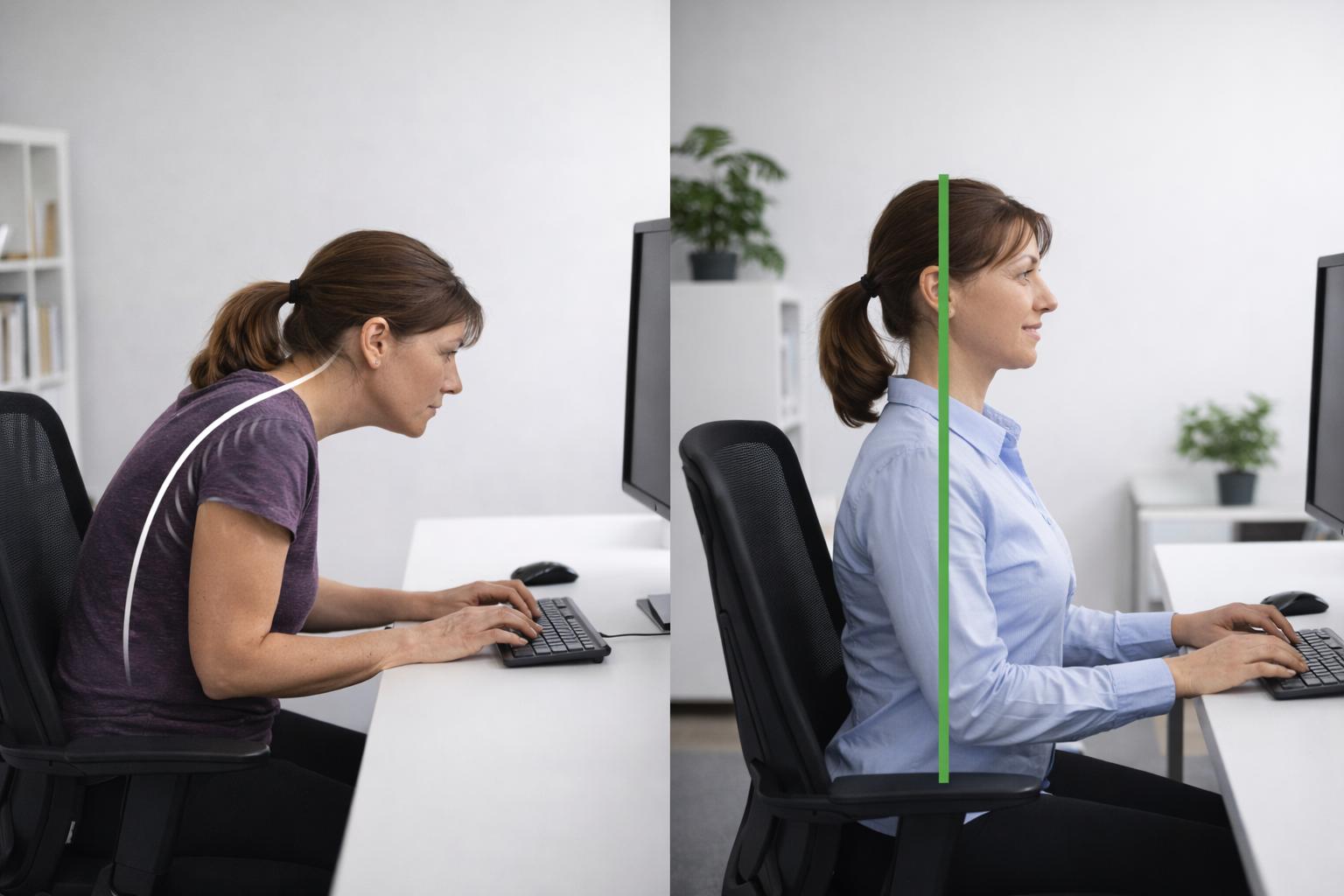
Bad posture does not suddenly age your skin overnight. However, rounded shoulders, forward head posture, jaw clenching, squinting, and repeated downward-looking positions can affect how your face, neck, and body look and feel.
Posture changes your silhouette. It influences the tension you carry through your neck and face. It can even affect the confidence and energy people see before you say a word.
And unlike many beauty treatments, improving it does not require another bottle on your bathroom counter.
Quick answer: Can bad posture make you look older? Slouching can create a more tired, compressed appearance by rounding your shoulders, bringing your head forward, and making neck and chest creases more noticeable. Strengthening your upper back, adjusting your screen position, and relaxing facial tension may help you look more open, energized, and confident.

Posture May Be the Most Overlooked Part of Your Beauty Routine
When we talk about looking more youthful, the conversation usually begins with skincare.
Cleanser. Serum. Moisturizer. Face treatments.
Those things matter, but your products are working on skin you carry around in the same position for hours every day.
Think about how much time you spend:
Looking down at a phone
Leaning toward a computer
Driving with your head forward
Carrying a heavy bag on one shoulder
Clenching your jaw while concentrating
Squinting because you forgot your sunglasses again
One minute in any of these positions is not the issue. The concern is repetition.
Over time, our bodies become very good at practicing the positions we use most.
Research has found an association between forward head posture and neck pain in adults, particularly as age increases. More recent evidence also suggests therapeutic exercise can improve forward head posture, rounded shoulders, and excessive upper-back curvature.
This is bigger than appearance. It is about helping your body remain strong, comfortable, and able to support the life you want to live.
1. Begin with the Simplest Anti-Aging Habit: Smile
One of my favorite beauty habits costs nothing and requires no special equipment.
Smile.
I am not talking about forcing a grin when life feels hard or pretending everything is fine. I mean allowing your face to soften and making room for genuine delight again.
A relaxed, authentic smile changes the energy of your whole face. Your eyes engage. Your cheeks lift. You appear warmer, more awake, and more approachable.
It also helps you notice what the rest of your face is doing.
Are you pressing your lips together?
Furrowing your brow?
Holding your breath?
Clenching your teeth?
Sometimes the fastest way to release facial tension is to pause, exhale, soften your eyes, and let a small smile interrupt the expression you have been unknowingly practicing all afternoon.
Your smile is not a cosmetic procedure. It is one of the ways your inner life becomes visible.
2. Strengthen the Muscles That Help You Stand Tall
Pulling your shoulders back for ten seconds may make you look taller, but lasting posture improvement requires more than repeatedly reminding yourself to “sit up straight.”
Your muscles need enough strength and endurance to support the position.
Many of us spend hours with our arms in front of us. We drive, type, scroll, cook, clean, hold grandchildren, and lean over projects. Our chest can feel tight while the muscles around the shoulder blades are not being challenged as often.
That is why upper-back exercises can be so helpful.
Try a reverse fly
You can perform a reverse fly with very light weights, resistance bands, or no added weight while learning the motion.
Stand or sit with your spine long.
Hinge slightly forward from your hips while keeping your back neutral.
Begin with your arms in front of you and elbows softly bent.
Open your arms outward as you gently draw your shoulder blades toward one another.
Return with control.
Imagine holding a pencil lightly between your shoulder blades. Avoid forcing your shoulders upward toward your ears.
Start with a small number of comfortable repetitions. Stop if you feel sharp pain, dizziness, numbness, or unusual discomfort.
Add a gentle chest opener
Stand tall and clasp your hands behind you. You may also hold a towel between your hands when clasping them feels uncomfortable.
Gently move your hands away from your body while drawing your shoulders down and back. You should feel an opening across the front of your chest, not pinching in your shoulders.
Breathe and hold the position briefly.
The goal is not to create a dramatic pose. You are teaching your body another way to carry itself.

3. Raise Your Screens to Help Reduce Tech Neck
Your phone is probably not getting any lighter, and your laptop is not going away.
The answer is to change how you meet the technology.
“Tech neck” is the common name used for the forward, downward head position many people maintain while using phones and computers. Staying in one position for long periods can contribute to neck and shoulder discomfort.
It can also change your appearance in the moment. Your head moves forward, your shoulders round, and the skin around your neck naturally folds as you look down.
Try these adjustments:
Raise your computer screen closer to eye level.
Bring your phone upward instead of dropping your head toward it.
Support your forearms when working for long periods.
Place both feet on the floor when possible.
Change positions regularly instead of searching for one “perfect” posture.
Take brief movement breaks throughout the day.
Rather than becoming rigid, keep returning your body to a comfortable, supported position.
4. Notice What Your Handbag Is Doing to Your Shoulders
There is a particular kind of purse carried by women who are prepared for everyone’s possible emergency.
It contains water, snacks, tissues, receipts, chargers, medicine, sunglasses, lip balm, pens, and one mysterious item no one remembers placing there.
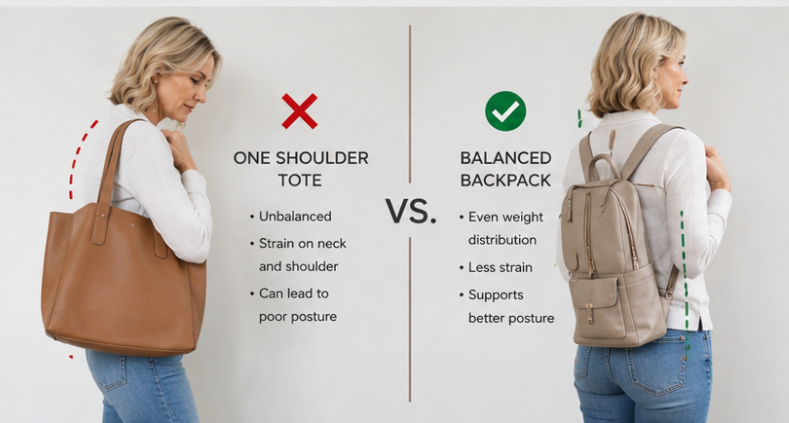
The bag may be helpful. Carrying all that weight on the same shoulder every day may be less helpful.
A heavy one-sided bag can cause you to hike one shoulder, shift your torso, or lean in the opposite direction to compensate.
You do not have to abandon the bag you love. Begin by paying attention.
Lighten it when possible. Alternate shoulders. Use a crossbody strap that fits comfortably or choose a backpack that distributes weight across both shoulders.
Your body should not have to perform a balancing act every time you leave the house.
5. Rethink the Way You Sit
Crossing your legs is not automatically disastrous, and you do not need to panic every time one knee drifts over the other.
The larger issue is remaining in an uneven position for a long time, especially when you always cross the same way.
You may notice one hip lifting, your torso turning, or more weight settling into one side of your body.
Try placing both feet on the floor for part of the day. Let your hips remain level, sit back into the chair, and avoid perching forward for hours.
Then move.
Stand up. Walk around. Shift your position. Stretch your hips.
Bodies were built for movement, not for holding a beautifully aligned pose until lunchtime.
6. Your Face Has a Posture, Too
Your shoulders are not the only place you may be holding tension.
Consider what happens to your face when you are worried, focused, hurried, or frustrated.
You may:
Clench your teeth
Press your tongue tightly
Purse your lips
Squint at a screen
Furrow your brow
Lift one eyebrow repeatedly
Tighten the muscles in your jaw
Teeth clenching and grinding, known as bruxism, can contribute to tired or tight jaw muscles and pain in the jaw, neck, or face. Stress and anxiety may also increase clenching in some people.
Every facial line is not evidence you did something wrong. Expressions are part of being alive.
The goal is to notice tension you do not need to carry.
Several times a day, try this quick facial reset:
Allow your upper and lower teeth to separate slightly.
Relax your lips.
Let your shoulders drop away from your ears.
Unfurrow your brow.
Take one slow breath.
Ask yourself, “Where am I gripping?”
For persistent jaw pain, clicking, locking, headaches, or signs of tooth grinding, speak with a dentist or qualified healthcare professional. TMD includes a range of conditions affecting the jaw joints and the muscles controlling jaw movement, so ongoing symptoms deserve individual evaluation.

7. Use Gentle Facial Massage as a Reset
A short facial massage can become a cue to slow down, relax tense muscles, and pay attention to how you are holding your face.
You can use clean hands, a facial roller, or a gua sha tool. Apply enough skincare product to create slip, then use slow, comfortable movements rather than dragging the skin.
Keep the pressure gentle, especially around the eyes and on sensitive areas.
Facial massage should feel calming. More pressure does not automatically create better results.
You might pair it with a simple question:
What am I carrying in my face today?
Sometimes you will discover your jaw has been tight since breakfast. Sometimes your brow has been braced through an entire conversation. Sometimes you simply need a quiet minute to return to yourself.
A Five-Minute Posture Reset You Can Do Today
You do not have to fix everything at once.
Try this five-minute reset:
Minute 1: Ground your body
Place both feet on the floor. Let your ribs rest over your hips and allow the crown of your head to rise naturally.
Minute 2: Open your chest
Perform a gentle chest-opening stretch while breathing slowly.
Minute 3: Wake up your upper back
Complete a comfortable set of reverse flies or shoulder-blade squeezes.
Minute 4: Relax your face
Separate your teeth, relax your brow, and release your shoulders.
Minute 5: Reset your environment
Raise your screen, lighten your bag, or move the item that keeps pulling you into an uncomfortable position.
Five minutes will not transform your posture forever. It can interrupt the pattern long enough to help you notice what your body has been asking for.
And noticing is where change begins.

Looking Youthful Is About More Than Removing Wrinkles
There is a reason standing tall changes more than the image in the mirror.
When your shoulders open and your head lifts, you take up your God-given space differently.
You look present.
You appear ready to participate.
You are no longer physically folding yourself away from the room.
This is why I never want beauty to become a desperate attempt to erase every sign you have lived. Beauty can be a form of stewardship. It can support the woman you are becoming and the calling you are preparing to carry.
Your posture will not determine your worth.
It can, however, help your outside reflect the strength, warmth, and confidence God is building inside you.
Start with one habit.
Lift your screen.
Relax your jaw.
Strengthen your upper back.
And perhaps, before you leave this page, sit a little taller and smile.
You may already feel the difference.
Let's make life beautiful again - together.
Much love,

Want personalized help understanding what your skin may need in this season? Complete my free skin analysis and receive recommendations designed around your skin, habits, and goals.
Want to Join Us Live?
You're invited to hang out with us every Wednesday at 1:30pm CST for our weekly livestream!
Just join the Facebook group to watch live, grab the free workbook that goes with each session, and be part of a community of women making life beautiful again—together.
Missed it live?
You can always catch the video replay on YouTube or listen in on your favorite podcast platform (just click below).
FAQ
Can bad posture really make you look older?
Bad posture can make you appear more tired or compressed by rounding your shoulders and moving your head forward. Looking downward may also make natural neck folds and chest creases more visible. Posture is only one influence on appearance and does not directly determine how quickly your skin biologically ages.
Can fixing my posture make me look younger?
Improved posture can make you look taller, more open, and more energetic. It may also reduce the hunched appearance associated with rounded shoulders and forward head posture. Results depend on your habits, strength, mobility, and any underlying health conditions.
What muscles should I strengthen to improve rounded shoulders?
Exercises often focus on the upper and middle back, shoulder stabilizers, core, and the broader posterior chain. A physical therapist or qualified fitness professional can help select appropriate exercises when you have pain, injuries, osteoporosis, or movement limitations.
How can I prevent tech neck while using my phone?
Bring your phone closer to eye level, support your arms, change positions frequently, and take regular movement breaks. Avoid holding your head in a steep downward position for extended periods.
Does jaw clenching change the way my face looks?
Clenching may make the jaw muscles feel tight, tired, or sore. Chronic teeth grinding can also affect dental health. A relaxed jaw may give the face a softer appearance, but persistent clenching, pain, clicking, or tooth wear should be discussed with a dentist or healthcare professional.
Does facial massage remove wrinkles?
Facial massage is unlikely to permanently remove established wrinkles. It may temporarily help you relax facial tension and can be a calming part of a skincare routine. Use gentle pressure and enough product to avoid pulling the skin.
How long does it take to improve posture?
There is no universal timeline. Your starting point, daily habits, consistency, strength, mobility, and medical history all matter. Small improvements in awareness may happen quickly, while strength and movement changes usually require consistent practice.
Should my tongue always press against the roof of my mouth?
The tongue commonly rests gently against the palate, but forceful pressing or internet “mewing” routines should not be treated as a cure for facial aging or jaw disorders. Seek professional guidance for breathing problems, jaw pain, swallowing concerns, or bite issues.